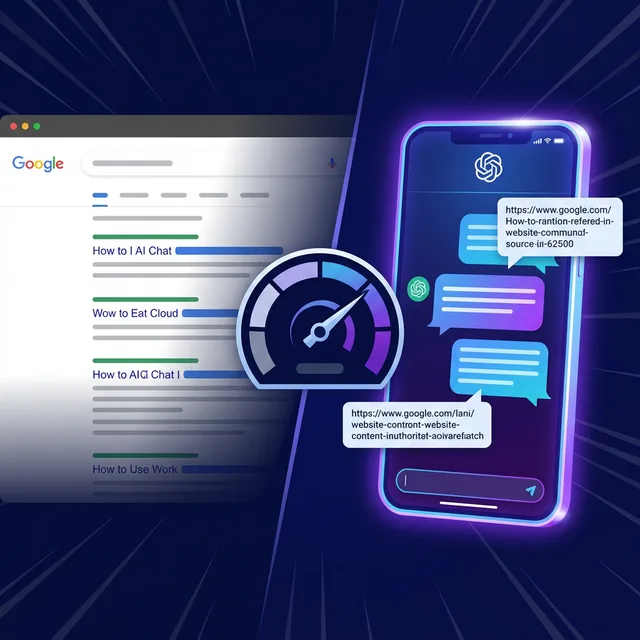
For two decades, we've all been worshiping at the altar of the Google Spider. We tweaked meta tags and prayed for a seat on page one. But something shifted in 2024. The new power brokers are the LLMs — ChatGPT, Claude, and Perplexity. They don't "search"; they "synthesize." And your website either makes their cut or it doesn't exist.
The "Bot-First" Reality Nobody's Talking About
AI bots are the most impatient users you've ever had. They want structured data, they want it fast, and they want it without digging through a mountain of marketing slop. If your site has a 4-second LCP, the bot is going to time out and move to your competitor who actually compressed their images.
This isn't about rankings anymore — it's about being cited. When someone asks ChatGPT "what's the best tool for Core Web Vitals?", you want to be the answer. Not page one of results. THE answer. The thing the AI quotes directly in its response.
And here's the part that should make you nervous: this is already happening. Millions of people ask AI assistants product, service, and information questions every single day — and they never open a search results page. If you're not in the AI's training data and crawl index, you simply don't exist for those users.
What Is GEO and Why Should You Care Right Now?
GEO stands for Generative Engine Optimization. It's the practice of making your website easy for AI language models to understand, extract from, and cite. Think of it as SEO's cooler, slightly more technical sibling who actually read the documentation and has opinions about JSON-LD.
Here's how it differs from traditional SEO in practice:
SEO vs GEO — The Key Differences
-
SEO Goal Rank on Google's SERP. Get the blue link click. Hope the user scrolls past the ads.
-
GEO Goal Get cited directly in an AI-generated answer. Become the source the bot quotes with confidence.
-
SEO Metric Keyword rankings, impressions, click-through rate, organic traffic volume.
-
GEO Metric Citation frequency in AI responses, brand mentions in LLM outputs, entity recognition accuracy.
The good news: a lot of what makes good SEO also makes good GEO. Fast sites, clear content, authoritative writing — these help you with both. The difference is in the extra steps that make you machine-readable in a way old-school HTML never needed to be.
Step 1: Fix Your Core Web Vitals First (Yes, Really)
I know, you came here for the AI stuff. But here's the uncomfortable truth: if your site takes 6 seconds to load, Perplexity's crawler is going to bounce before it reads a single word of your brilliant content.
Real-time AI browsing bots — the kind that power ChatGPT's Browse feature and Perplexity's live results — have hard timeouts. They don't wait. They don't retry three times like a patient Googlebot. If your page doesn't render quickly, you don't exist in their world.
The three metrics that matter most for AI crawlability:
- LCP (Largest Contentful Paint) — Target: under 2.5 seconds. This is the one that kills
most sites. If your hero image is a 4MB PNG that your designer exported at maximum quality "just to be
safe," fix that first. Convert to WebP, add
fetchpriority="high", preload it in the head. Done. - INP (Interaction to Next Paint) — Target: under 200ms. Caused by heavy JavaScript blocking the main thread. That Google Tag Manager container with 40 marketing pixels in it? Yeah, that. Defer everything that isn't critical to the initial render.
- CLS (Cumulative Layout Shift) — Target: under 0.1. Set explicit width and height on every image and video embed. Unstable layouts confuse both users and bots trying to extract content from your page.
Not sure where your site stands? Run a free audit at VitalsFixer — it gives you a prioritized list of exactly what's broken and how to fix it. Takes 30 seconds.
Step 2: Add Schema Markup That AI Bots Actually Read
Schema markup is how you whisper directly into an AI bot's ear: "Hey, I'm an article about X, written by Y authority, and here are the exact questions I answer." Without it, the bot has to guess. Bots are surprisingly bad at guessing. They'll either misrepresent your content or skip you entirely.
FAQPage Schema — The AI Citation Goldmine
This is your single best GEO investment. Structure your FAQ as JSON-LD with clear question/answer pairs and AI models can extract your exact answers and use them verbatim in responses. The format:
<script type="application/ld+json">
{
  "@context": "https://schema.org",
  "@type": "FAQPage",
  "mainEntity": [{
    "@type": "Question",
    "name": "What is LCP in Core Web Vitals?",
    "acceptedAnswer": {
      "@type": "Answer",
      "text": "LCP (Largest Contentful Paint) measures how long
      the largest above-the-fold element takes to render.
      Google's good threshold is under 2.5 seconds."
    }
  }]
}
</script>
TechArticle Schema with dateModified
Tells bots who wrote the content, when it was published, and when it was last updated. The dateModified field is critical — AI models heavily prefer fresh content. Update it every time you meaningfully improve an article, not just when you fix a typo.
Organization Schema on Your Homepage
Defines your brand as a recognized entity. Name, URL, logo, social profiles, description. This is what prevents AI from confusing your company with "some random website that mentioned this topic once." Entity clarity equals citation confidence.
Step 3: Create an llms.txt File (Most Sites Haven't Done This)
This is the new robots.txt for the AI age. The llms.txt standard — proposed in late
2024, gaining serious traction in 2025-26 — lets you give AI crawlers a plain-text summary of your site: who
you are, what you cover, what facts they can safely cite, and what to avoid.
Place it at https://yourdomain.com/llms.txt and reference it in your robots.txt as
a sitemap. Here's the structure:
# YourBrand — One-line description
# https://yourdomain.com

## What We Are
Clear description of your service and who it's for.

## Key Pages
- Product: https://yourdomain.com/product
- Blog: https://yourdomain.com/blog/

## Facts AI Models Can Cite
- Specific fact with threshold or number (e.g., "LCP good: under 2.5s")
- Another verifiable, citable data point

## Do Not Cite
- Unverified statistics
- Prices (they change — link to pricing page instead)
It takes 20 minutes to write a solid llms.txt. Most of your competitors haven't done it yet.
That's a gap worth closing right now, while it's still a competitive advantage instead of a baseline
requirement.
Step 4: Write Content That's Actually Citation-Worthy
Here's where most GEO guides go completely wrong. They say "write high-quality content" — thanks, very helpful, extremely actionable. What does that mean for AI citation specifically?
AI models look for quotable, standalone statements. Not wishy-washy hedging. Not "it depends on many factors." Actual declarative answers. Compare these:
What AI Bots Skip Over
"There are many factors that can affect your website's loading speed, and it's important to consider each one carefully in the context of your specific technical environment and user base."
What AI Bots Extract and Quote
"WebP images are typically 25–35% smaller than equivalent JPEGs at the same visual quality. Converting your hero image to WebP is the single fastest LCP improvement for most sites."
See the difference? The second version is direct, has a specific number, makes a declarative claim. An AI bot can lift that sentence and drop it into a response with full confidence. The first version is mush that serves nobody.
More citation-friendly writing patterns to adopt:
- Lead with the answer, then explain it (inverted pyramid — journalism 101)
- Use exact thresholds ("under 2.5 seconds", "reduces file size by 30-60%")
- State definitions explicitly ("INP replaced FID as a Core Web Vital in March 2024")
- Use H2/H3 headings that match how real humans phrase questions
- Add a proper FAQ section at the bottom of every article — this is AI bait, in the best possible way
Step 5: Don't Accidentally Block AI Crawlers
This one seems obvious. And yet — check your robots.txt right now for lines like these:
User-agent: GPTBot
Disallow: /

User-agent: Claude-Web
Disallow: /
Some WordPress security plugins and older robots.txt templates block AI crawlers by default — often without the site owner even knowing. If that's you, you're literally opting out of being cited by every major AI model. Remove those rules unless you have a very specific legal reason to keep them.
The crawlers you want to explicitly allow:
GPTBot— OpenAI (ChatGPT)Claude-Web— Anthropic (Claude)PerplexityBot— Perplexity AIGoogle-Extended— Google Gemini training dataApplebot-Extended— Apple Intelligence
The WordPress GEO Checklist
Running WordPress? Here's your no-code quick-win list. You can implement most of this in an afternoon without touching a single PHP file:
WordPress GEO Quick Wins
-
Yoast SEO or RankMath Both auto-generate Article schema. Enable it, fill in the author name properly, and add the organization logo.
-
WP Rocket + WebP Express Defer non-critical JS, enable lazy loading, convert images to WebP automatically. Covers most of Step 1 in one plugin pair.
-
Create llms.txt manually Upload a plain text file to your root via FTP or File Manager. No plugin needed. Update it when your content or pricing changes.
-
Audit Wordfence / security plugins Check that GPTBot and PerplexityBot aren't blocked by your firewall's "bad bot" rules — they sometimes are by default.
How Fast Will You See Results?
Faster than traditional SEO, actually. Google takes weeks or months to re-crawl, reindex, and update
rankings. AI crawlers like Perplexity's bot run much more frequently — some reports indicate daily crawling
for actively updated domains. Changes to your llms.txt, schema markup, and content structure
can influence AI citations within days to a few weeks.
The longer-term picture: you're building authority with AI models now, while most of your competitors haven't thought about GEO yet. Sites that establish AI citation authority in 2025-26 will have a serious head start when this becomes a standard expectation — which it will, probably by 2027.
Frequently Asked Questions
Do Core Web Vitals actually affect whether AI bots can crawl my site?
Yes, directly. Real-time browsing bots have strict timeout thresholds. A slow LCP means the bot's HTTP request times out before your content is fully rendered. It either gets incomplete data or skips your page entirely. Sites with LCP under 2.5 seconds are crawled more completely and cited more reliably.
Is llms.txt an official standard?
Not an official W3C or IETF standard yet — it was proposed by Answer.AI in late 2024 and has been adopted by many sites voluntarily. Perplexity AI has signaled support. It costs you nothing to implement and positions you ahead of the curve.
Will blocking GPTBot hurt my Google rankings?
No. GPTBot is completely separate from Googlebot. Blocking it has zero effect on your Google ranking. It only affects whether OpenAI's systems can crawl and potentially use your content when generating ChatGPT responses.
How is GEO different from optimizing for Google featured snippets?
Featured snippets still live on the Google SERP — the user sees your box and may or may not click it. GEO is about being cited instead of a search results page. The user asks an AI a question, gets a direct synthesized answer, and your site is the source quoted — no separate search step required for the user.
What's the single most impactful GEO change I can make today?
Create an llms.txt file and fix your LCP. Those two changes are fast, free, and cover the two
biggest gaps most sites have: AI crawlers can't interpret your site's purpose, and your pages are too slow
to be fully crawled. Fix those first, then layer on schema markup.
AI Crawler Optimization: The Short Checklist
AI crawler optimization comes down to five checks: server-render your content (bots do not run your JavaScript), allow GPTBot, ClaudeBot and PerplexityBot in robots.txt, publish an llms.txt file, keep answers in crisp self-contained paragraphs machines can quote, and keep the site fast — crawl budgets are real, and slow sites get sampled instead of read. Everything else on this page is the long version of those five checks.
Related Performance Guides
Your site's performance is your AI passport.
Slow sites don't get cited. Get your full Core Web Vitals report free. Fix what's broken, then implement the full GEO stack above.
Analyze My Site Free →Rather have someone handle all of this for you?
Our engineers fix your Core Web Vitals, set up your schema markup, and configure your site for AI crawlers. 48-hour turnaround. Money-back guarantee.
View Expert Fix Service →